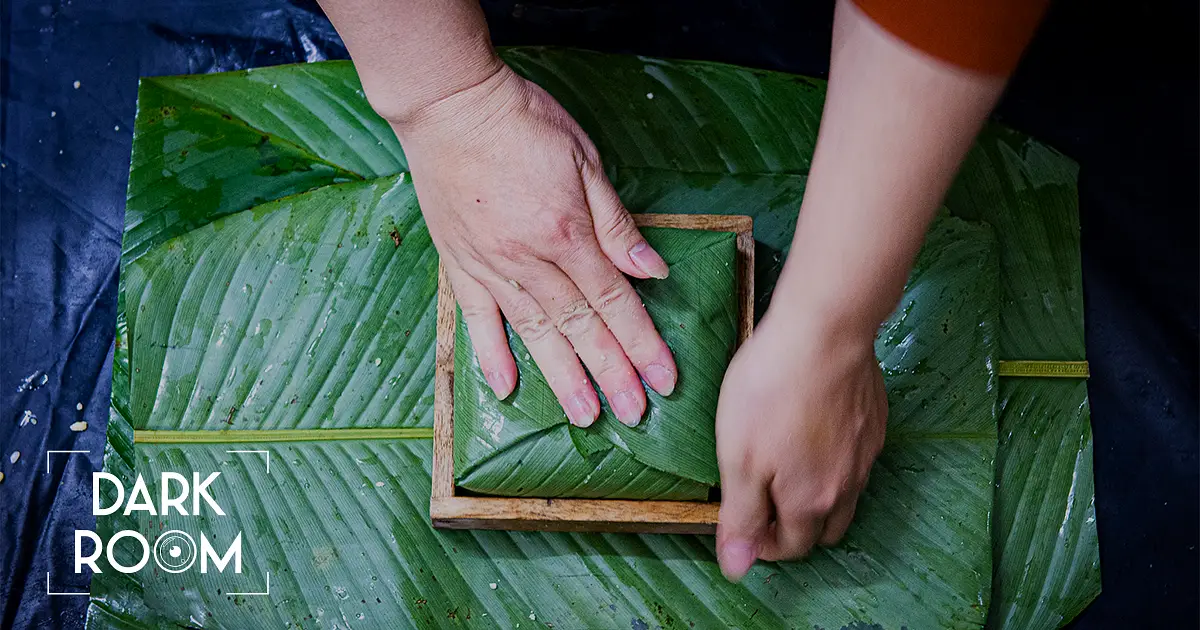
Much like the peach blossom or the lucky money envelope, Chung cake is a staple part of Tet.
It is a Vietnamese tradition for families to wrap and cook their own banh chung, a tradition that I have never experienced. I have no idea how to make a banh chung, and so this year, I want to change that.
My wife hails from Ho Khau village, one of Hanoi’s oldest villages. Situated where the To Lich River once met West Lake, the village used to be famous for its paper. Now, the river is covered and the water is polluted, so the paper craft is lost. Lucky for me, the art of banh chung still survives here.
Deep in the twisting alleys of the village, I come to the house of Dinh Thi Hoa. Her family has been making banh chung for almost two decades now, and she was happy to have me for a lesson.
Hoa just passed her middle age, yet her spirit is as young and jovial as anyone. Every other sentence of hers is accompanied by laughter. She learned how to make banh chung from her parents, who used to tell her: “If you don’t make it, then you won’t have anything to eat.”
Now she supplies banh chung for the village. “I do it to serve the community,” she laughed. “Now every house is so cramped, nobody has the space to do it. I see people’s need and I try to help them.” A banh chung operation can take a lot of space. And not only does Hoa’s house have a yard, hers is big enough for two fruit trees, one rose apple and one lekima.
Under the lekima’s shade, Hoa arranges various buckets and basins. A huge water tank stands nearby, filling two concrete barrels that were once personal bomb shelters. Here is the first workstation I see from the gate: a wet kitchen where all banh chung’s components are prepared before wrapping.


A typical banh chung is made up of five ingredients: dong leaf, rice, mung bean, pork, and bamboo strings; each component is meticulously prepared. The leaves have to be soaked for three days then scrubbed clean to prevent mold. The rice and beans are also soaked and washed with multiple waters. Hoa’s motto is: “We only sell things we would eat at home.”
Once the rice is cleaned, it is mixed with salt to add flavor. Mung beans are steamed then set before a fan to cool. “The beans must be cooled before wrapping,” Hoa explains, “otherwise they will sour everything.”

The beans fresh out of the steam pot are darker (left) than the cooled ones (right).
The wrapping station is inside the house, where Hoang Thanh Thai, Hoa’s sister-in-law, is in charge. Thai has also been making banh chung since she was a kid, she is so adroit that each cake only takes a few moments to be wrapped. I have to ask her to slow down so I can take a picture of each step of the process.

First she lays down two leaves as the outer layer, on top of which goes a square mold. Then she lines the sides and the bottom of the square with leaves, the greener side facing inward. Then she puts in one bowl of rice as the first layer, next is a scoop of beans, then a piece of pork, another scoop of beans to cover the meat, and one more bowl of rice on top. Afterward she folds the inner leaves to a tight square, then the outer layer is wrapped and tied with the bamboo strings.
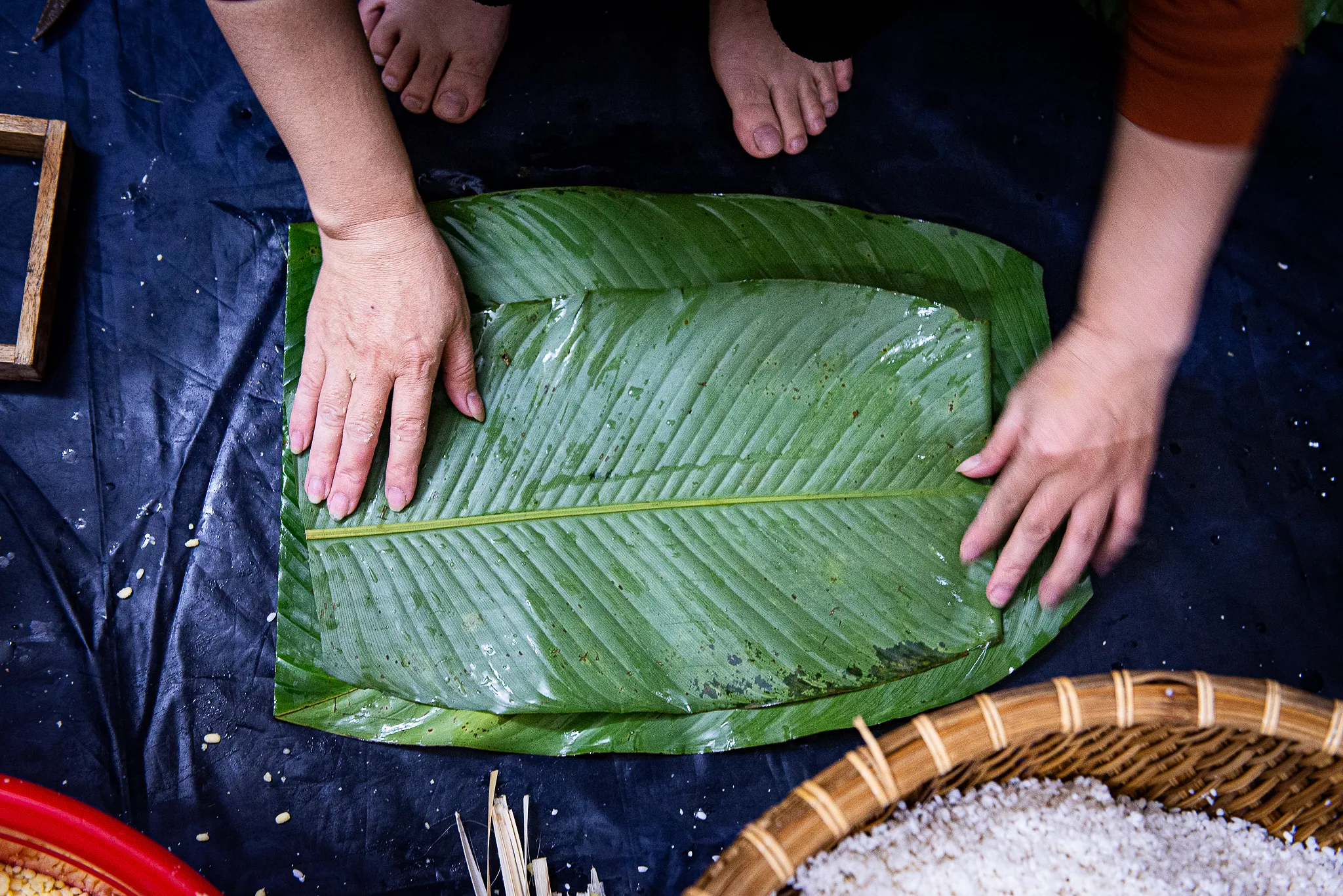


Afterward, fold the inner leaves to a tight square, then wrap the outer layer and tie it with bamboo strings.
Thai is gracious to let me try. I’m surprised to learn how much force it takes to wrap everything tightly, I also fumble with the strings and have to ask Thai for help. She ties the knots with one hand.
I asked Thai what is the secret to a good banh chung. “Oh that’s hard,” she laughed. “I think there’s no secret. We just choose good rice, good beans, and good meat.” For rice, her family uses the famous yellow flower cultivar. The beans must be crumbly after steaming, and the ideal pork for banh chung comes from the pig’s belly, which has both lean and fatty parts.
The leaves are important, too. Thai’s family uses leaves from dong, a plant similar to banana but is found mostly in the forest. The leaves must be of the right age, not too old and not too young, in order to give banh chung its signature color. Her family is making 400 Chung cake this year, which needs 2,000 leaves.
“Every other year I make a lot more, but my husband just passed away this year so I make fewer now,” Thai shares. Her husband, Hoa’s little brother, was in charge of the third station — boiling — and without him the family can’t handle the usual 800–1000 orders.
The family boils banh chung with firewood, the good old-fashioned way to make banh chung with amaranth, which means “supple and delicious.” Under the rose apple tree, Thai’s lipstick lays down some bricks for a makeshift fire pit, then he puts a huge pot on top. The pot can hold 60–70 banh chung at a time. After stacking the cake, he fills it with water then his aunt, Hoa, lights the fire.


There are three phases to the boiling process. First, the fire must be roaring to bring the pot to a boil. Then, a stable and constant flame is needed for the pot to simmer for 12 hours. Finally, towards the 10th or 11th hour, the fire is reduced to a smolder.
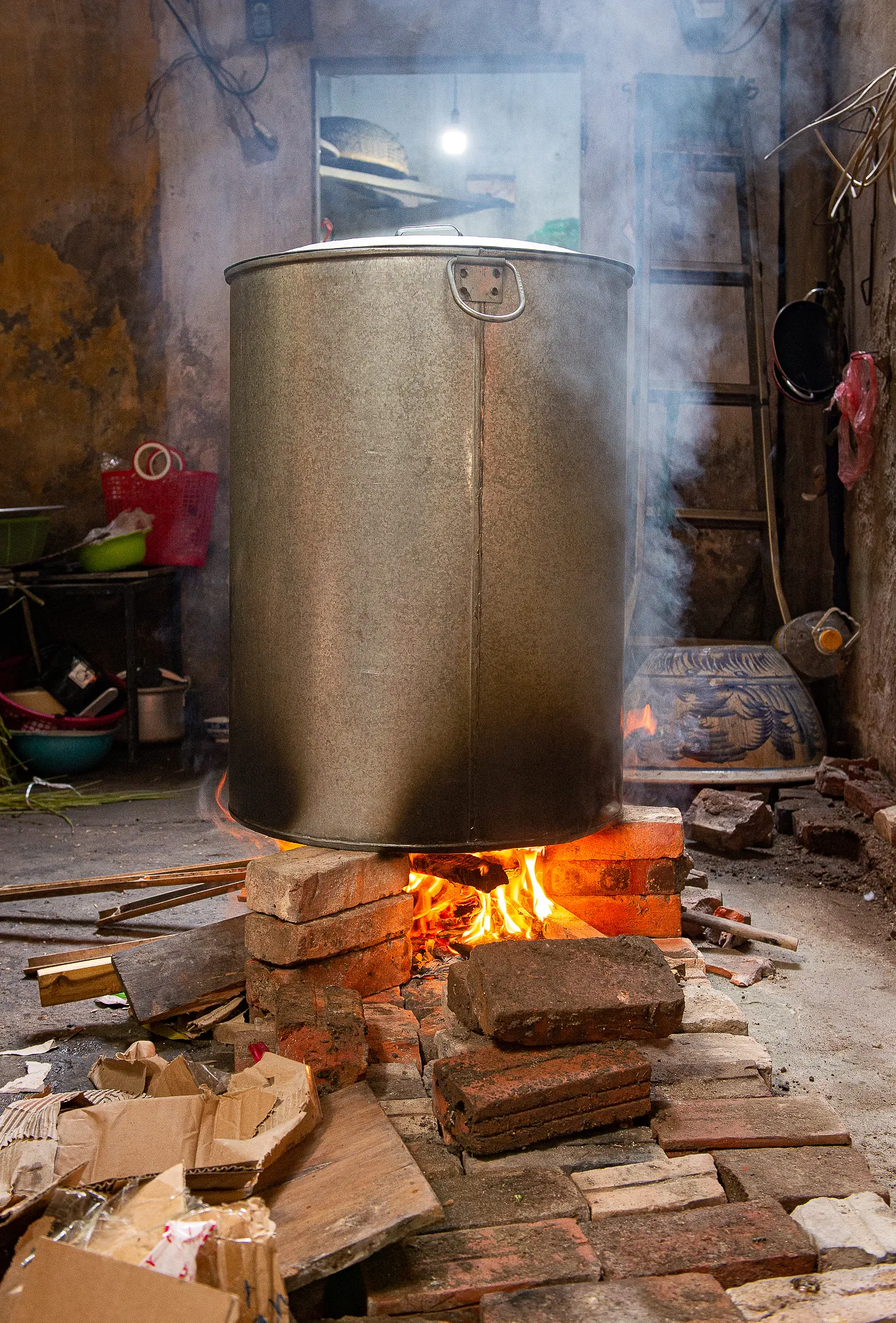
While the fire crackles merrily, I asked Hoa about Thang, her little brother. Before, each person in the family was in charge of a part of the process: Hoa prepared the ingredients, Thai wrapped, and Thang boiled. But this year, Thang had a stroke and spent two weeks in the hospital before he was gone. “It’s very sad,” Hoa says, her cheerfulness dampens. “This year we keep making Chung cake for some comfort, otherwise it’s just too sad.”
Thai is determined to keep the tradition, too. “I will do this for as long as I can,” she says, “if it’s only me then I’d only make one pot.” To fulfill the orders, this year, her family will need to boil seven pots, it is 4pm when the first one begins. I left the house and returned at 6am the following morning to see the final part of the process.
After 12 hours of simmering, the cake absorbs a lot of water. When they are taken out, they must be cleaned then pressed to force the excess water out. Thai arranges the banh chung on a table then sets three water jugs on top; they will remain like that for another six hours before delivery. Thai leaves the house to buy more meat for the next batch, another pot is already on the fire.


The family has only three days to finish all the orders before the new year; everybody is catching a moment of rest before continuing this marathon. The sky is still dark, all is quiet, the sweet aroma that is distinctive of Chung cake fills the air. As I sat there watching the fire, a thought — a feeling. feeling — swirls in me: Tet is here.
This article was originally published on Urbanist Hanoi in 2022.